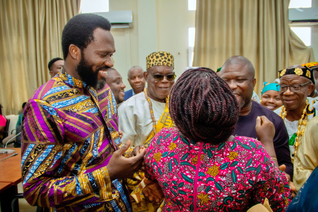


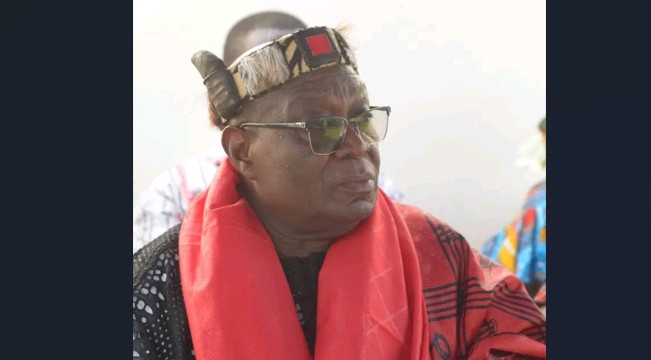
Togbi Dosu Adaku VIII has said the Adaku stool holds the title of Dufia in Atorkor because it is a war stool, and by Anlo custom only war stools carry that title.
He spoke to journalists in Atorkor on Monday, April 13, to outline what he called the historical and customary basis of his enstoolment and to address claims over the Dufiaship.
Togbi Dosu Adaku VIII traced the Adaku stool’s lineage and said it represents “valour, resilience, and adaptation across generations.” He listed the succession from Amable, known as Togbi Adaku I, in 1840; Akorli Ehuedakor as Togbi Adaku II; Apieke as Togbi Adaku III; Dosu as Togbi Dosu Adaku IV; Amekuodi as Togbi Dosu Adaku V; Ametefe as Togbi Dosu Adaku VI; Asemuasah Brown Yao as Togbi Dosu Adaku VII, enstooled on 15 July 1960; and Mensah Godwin Kwashie as Togbi Dosu Adaku VIII, enstooled on 18 January 2024.
He stressed that the Adaku stool is a war stool. Under Anlo tradition, he said, only occupants of war stools are recognised as Dufia. Occupants of Hozi, or wealth stools, do not receive the title. “A war stool commands, a wealth stool accumulates. Anlo does not confuse the two,” Togbi said.
“The Adaku stool remains unique to Atorkor and is never duplicated anywhere,” he added.
Giving historical context, Togbi said that in 1840 Togbi Atsieku I created the Adaku Stool for Atorkor by installing his nephew Amable as Adaku I. Amable was the son of Kokui Deakor, Atsieku’s elder sister, and Akorli Akposor of the Tsiame clan. He said Amable became both the first chief of Atorkor and the fourth commander of the left wing, Mia Awalogo, Lashibi, of the Anlo Kingdom, marking Atorkor’s formal recognition within the Anlo polity.
He explained that the Dosu stool was established later, also for gallantry in war. To prevent rivalry and ensure unity, the family merged the two stools into one institution: Dosu Adaku, with Dosu installed as Dosu Adaku IV. The fusion, he said, preserved both traditions while strengthening the family’s authority over Atorkor and Dosukope.
Togbi said the Akumey Geli Adjorlolo family have elevated their Hozi and are now claiming the Dufia title, which he described as contrary to Anlo custom. Traditionally, he said, chiefs were not installed on Hozi. He cited historical figures such as Gbele, Ndorkutsu, and Adjorlolo — originally named Atitsogbi — as wealthy traders who were never chiefs. The Adjorlolo stool, he said, symbolised wealth rather than political authority.
To support the distinction, Togbi referenced Mamattah’s Ewes of West Africa (1976). He said page 156 of the book refers to Atorkor as “Akplorkplorti Deakor fe anyigba… and Adaku 1.” He added that page 222 contains a table that recognised Togbi Adaku I as Dufia of Atorkor and recognised Akumey Geli as Fia of Atorkor, maintaining the customary difference between a war stool and a wealth stool.
Togbi concluded that Atorkor was founded by Dodi Fuga of the Klevie clan. He said the name Atorkor is derived from the Akan phrase “metor makor” meaning “I buy and leave,” reflecting how Akan traders made quick transactions at the settlement before leaving due to mosquitoes.
According to Togbi, Dodi acquired the land “Apimwornu to Sorglor a.k.a Akplowotorkor.” In founding the place as Klevie land, he said, the deity Mama Adexe was established there in ADEXEFE. “There is no doubt therefore that Atorkor is situated on Klevie clan land,” Togbi said.